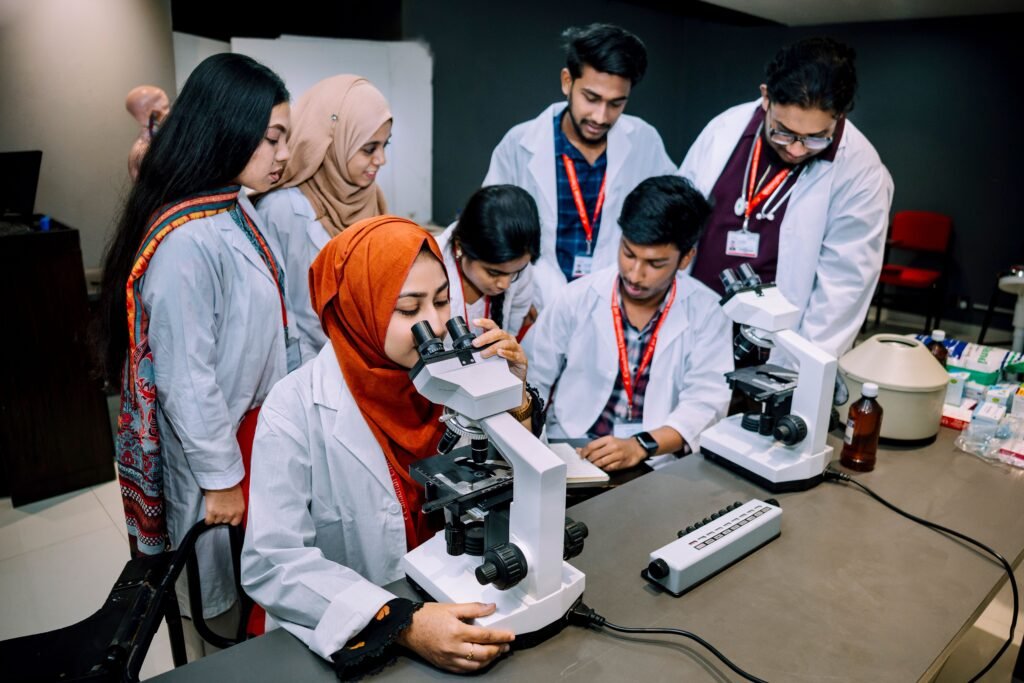
A research internship in India is a short, supervised project at a research institute or university — usually 4 to 8 weeks in the summer — where you work with a scientist on a real problem. This guide explains the two ways to find one, the programmes that take external students, and the order to work in so you do not miss a deadline.
On this page
- The answer in short
- Start with structured programmes
- Build a shortlist that fits your year and marks
- Prepare your documents, then email professors
- Track deadlines on a year-ahead calendar
- Common mistakes
- Your checklist
- What to do next
- Frequently asked questions
- Sources checked
The answer in short
There are two routes to a research internship in India. The first is a structured programme — a published call with a form, a deadline and a selection list — such as the Science Academies’ Summer Research Fellowship Programme (SRFP), the Jawaharlal Nehru Centre for Advanced Scientific Research (JNCASR) Summer Research Fellowship Programme, and the summer programmes run by IISER Pune and the Tata Institute of Fundamental Research (TIFR) Hyderabad. The second route is a direct email to a professor, asking to work in their lab. A structured programme has published rules, dates and eligibility; a direct email has no form and no deadline, and it works best when you can name a specific paper or project from that professor’s group. Try the structured programmes first, use direct emails as a second route, and start at least six months before the summer you want.
Start with structured programmes
These programmes take external students every year. Treat the details below as worked examples from published calls, and always confirm the current call on the official page before applying — dates and rules change every year.
Science Academies’ Summer Research Fellowship Programme (SRFP). Run jointly by the Indian Academy of Sciences (IASc), Bengaluru, the Indian National Science Academy (INSA), New Delhi, and the National Academy of Sciences, India (NASI), Prayagraj. For 2027, applications closed on 30 November 2026; the fellowship lasts about two months. Eligibility is by exact course and year — BS/BSc second year only, MS/MSc first year only — with at least 65% in core subjects (excluding languages) from Class X onwards. Regular PhD students are not eligible, anyone who has held an Academies fellowship twice cannot apply again, and only one application may be submitted.
JNCASR Summer Research Fellowship Programme. Run by the Jawaharlal Nehru Centre for Advanced Scientific Research, Bengaluru, since 1991. Selected students spend two continuous months, April to July, under scientists at the Centre or other premier institutes. The fellowship is ₹12,500 per month (about $140), with travel support. Applicants need at least 65% in aggregate and core subjects (excluding languages) in Class X and Class XII, at least 60% in previous semesters, and Mathematics in both Class X and Class XII.
IISER Pune Summer Student Programme. The Indian Institute of Science Education and Research (IISER) Pune invites students from other institutes to work on short-term projects under its faculty. For 2026 it ran 4 to 8 weeks, roughly 15 May to 21 July 2026, for 2nd, 3rd or 4th year BSc/BTech/BE or 1st year MSc/MTech students with about 60% aggregate marks, with a maximum of two listed projects per student. There is no stipend; selected students receive free hostel accommodation and pay mess charges of around ₹6,000 per month (about $68).
TIFR Hyderabad Visiting Students’ Research Programme (VSRP). An 8-week summer programme, May to July, for final-year BSc students and pre-final or final-year MSc, Integrated MSc, 4-year BSc or BTech/BE students. PhD students are not eligible. For 2026, the last date was 31 January 2026, and selected students were paid ₹9,000 per month (about $100) with travel reimbursement as per TIFR rules. The National Centre for Radio Astrophysics (NCRA-TIFR), Pune, runs its own VSRP for students entering the final year of a Bachelor’s or Master’s degree in Physics, Mathematics, Electronics or Engineering, from the second week of May to the first week of July, with a February deadline.
Build a shortlist that fits your year and marks
Do not apply to every programme you find. A shortlist of six to ten programmes, matched to your actual year and marks, beats thirty random applications. First, write down your facts: your degree, your current year, your aggregate marks in core subjects from Class X onwards, and your discipline. Then check each programme’s eligibility table against those facts. The SRFP rules show why this matters — a BSc student qualifies only in the second year, and an MSc student only in the first year. Sort it into three groups: structured programmes, institute programmes, and professors to email directly. For each item, note the application window, the documents needed, and whether a referee is required — a referee needs at least two weeks’ notice.
Prepare your documents, then email professors
Most summer calls open between December and February and close within four to eight weeks, so prepare your documents in November or December: a one-page CV; a statement of purpose of 300 to 500 words (what you want to work on, what you have done, and why that institute); scanned marksheets from Class X onwards in one PDF; and one referee who has agreed in advance.
A good email to a professor is short, specific and honest: a clear subject line (“Summer research internship enquiry — 2nd-year BSc Physics, [Your College]”), one paragraph on who you are and what you have done, one paragraph on why that professor’s work interests you — naming a paper or project — and one line asking whether the group accepts summer students and what the process is. Attach your CV as a PDF, send it in the morning on a weekday, and if there is no reply in two weeks, send one polite follow-up and then move on. Do not send the same email to every professor in a department, and do not claim skills you do not have.
Track deadlines on a year-ahead calendar
As a guide to the rhythm — not as dates for the next cycle, which you must confirm on each official page — the recent pattern was: SRFP closed 30 November 2026; TIFR Hyderabad VSRP closed 31 January 2026; JNCASR SRFP 2026 ran 22 December 2025 to 31 January 2026 (secondary source); IISER Pune closed 20 February 2026 (secondary source). The biggest national calls close first, in November and January; institute programmes follow in February and March. Plan backwards from November: documents by October, applications from November to February, emails from December to March, internship in May to July.
Common mistakes
- Applying in the wrong year. Eligibility is year-specific. Check the table before you apply.
- One generic email to fifty professors. It reads as generic, and it is ignored as generic.
- No referee arranged in advance. A referee asked the day before a deadline will often decline.
- Ignoring the money. Some programmes pay a stipend; some, like the IISER Pune programme, pay no stipend and charge mess fees. Work out the cost before you accept, not after.
- Applying only to one programme. National programmes are competitive and merit-based. Apply to several, and keep the direct-email route open at the same time.
Your checklist
- Degree, year, marks and discipline written down
- Shortlist of 6–10 programmes, matched to eligibility
- One-page CV ready as a PDF
- Statement of purpose of 300–500 words drafted
- Marksheets scanned into one PDF
- One referee agreed, with two weeks’ notice
- Email template adapted per professor, not copied
- Deadline calendar made, working backwards from November
- Each application’s official page checked on the day you apply
What to do next
Start on the Internships hub, then read the guides on emailing a professor and on writing your CV for a research internship. First- or second-year students should read the guide on starting in research as an undergraduate first.
Frequently asked questions
Do I need prior research experience to get a research internship in India?
No. Most structured programmes select on academic merit — marks, year and a clear statement of interest — not on prior research. A first internship is meant to be a first experience.
Can I apply to more than one programme at the same time?
Yes, across different programmes. Within the Science Academies’ SRFP, only one application may be submitted — submitting more than one means none is considered. Check each programme’s own rule.
Are research internships in India paid?
It depends on the programme. The JNCASR SRFP states ₹12,500 per month (about $140) with travel support, and the TIFR Hyderabad VSRP states ₹9,000 per month (about $100) with travel reimbursement. The IISER Pune programme states no stipend, with free hostel accommodation and mess charges of around ₹6,000 per month (about $68) paid by the student. Check each notification before you apply.
Sources checked
- Science Academies’ Summer Research Fellowship Programme 2027 — official application portal, https://webjapps.ias.ac.in/fellowship2027 — checked 19 November 2026 (deadline, organisers, duration, eligibility years, 65% rule, one-application rule, PhD exclusion).
- JNCASR Summer Research Fellowship Programme — official page, https://www.jncasr.ac.in/academic/fandeprogrammes/srfp/ — checked 19 November 2026 (since 1991, two months April–July, ₹12,500 per month, 65% and 60% marks rules, Mathematics requirement). Note: secondary coverage of the 2026 cycle reported a fellowship of ₹10,000 per month; the figure used here is the one currently stated on the official page. The 2026 application window (22 December 2025–31 January 2026) is from secondary coverage, not the official page.
- IISER Pune Summer Student Programme 2026 — official project pages, https://www.iiserpune.ac.in/SummerStudentProgrammes/Apply/12/drivers-of-plant-community-assembly-in-a-tropical-savanna, and India Science, Technology & Innovation portal listing, https://www.indiascienceandtechnology.gov.in/internships/summer-student-programme-2026-iiser-pune-%E2%80%8B — checked 19 November 2026 (4–8 weeks, 15 May–21 July 2026, eligible years, about 60%, no stipend, free hostel, mess about ₹6,000 per month, maximum two projects). The 20 February 2026 closing date is from secondary coverage of the 2026 cycle, not the official page.
- TIFR Hyderabad Visiting Students’ Research Programme — official page, https://www.tifrh.res.in/academics/vsrp/ — checked 19 November 2026 (8 weeks May–July, eligible years, PhD not eligible, 31 January 2026 deadline, ₹9,000 per month plus travel).
- NCRA-TIFR Visiting Students’ Research Programme — official page, https://www.ncra.tifr.res.in/students/external-students — checked 19 November 2026 (final-year students, second week of May to first week of July, February deadline).
- IndiaAI Fellowship 2026–27 — official portal, https://fellowship.indiaai.gov.in/ — portal could not be reached on 18 November 2026; amounts and dates in this guide are not taken from it.
- Currency conversions in this guide use about ₹88 to $1 and are labelled “about”.